Skip to content

Hand Tracking for Physical AI#

This example uses daft-physical-ai, a Daft extension for physical AI data pipelines. It reads a LeRobot dataset, runs hand tracking (MediaPipe) as a Daft UDF with track_hands, and shows the keypoints.

Setup#

Install with pip install "daft-physical-ai[mediapipe]" matplotlib, then import.

1
2
3
from daft.datasets import lerobot

from daft_physical_ai.hands import track_hands

Configure#

The dataset, the camera column to decode, and how many frames to run.

1
2
3
DATASET = "pepijn223/egodex-test"
IMAGE_COLUMN = "observation.image"
LIMIT = 12

Read the dataset#

The LeRobot reader gives one row per frame, decoding the camera into an image column.

1
df = lerobot.read(DATASET, load_video_frames=IMAGE_COLUMN).limit(LIMIT)

Track hands#

track_hands returns a hand-pose column: a list of detected hands per frame, each with handedness (left or right), confidence (detection score), kp2d (21 hand keypoints in image pixels), and kp3d (3D keypoints, for methods that produce them - null for MediaPipe). It's a lazy, batched Daft UDF, so nothing runs until we materialize below.

1
df = df.with_column("hands", track_hands(df[IMAGE_COLUMN], method="mediapipe"))

Inspect the results#

.show() triggers execution and renders the keypoints per frame.

1
df.select("episode_index", "frame_index", "hands").show()
episode_index frame_index hands
0 0 [{handedness: right, confidence: 0.9790868, kp2d: [[1409.5848, 1109.521], ...], kp3d: None, }, {handedness: right, confidence: 0.7482122, kp2d: [[954.672, 1074.0482], ...], kp3d: None, }]
0 1 [{handedness: right, confidence: 0.98324096, kp2d: [[1406.2035, 1108.8458], ...], kp3d: None, }, {handedness: right, confidence: 0.76023126, kp2d: [[954.5771, 1071.5254], ...], kp3d: None, }]
0 2 [{handedness: right, confidence: 0.97795737, kp2d: [[1410.8853, 1107.5798], ...], kp3d: None, }, {handedness: right, confidence: 0.82196695, kp2d: [[953.91736, 1076.048], ...], kp3d: None, }]
0 3 [{handedness: right, confidence: 0.9760107, kp2d: [[1411.5732, 1105.092], ...], kp3d: None, }, {handedness: right, confidence: 0.82673466, kp2d: [[955.222, 1073.2001], ...], kp3d: None, }]
0 4 [{handedness: right, confidence: 0.9784236, kp2d: [[1411.9012, 1102.4144], ...], kp3d: None, }, {handedness: right, confidence: 0.79153925, kp2d: [[950.6265, 1077.1145], ...], kp3d: None, }]
0 5 [{handedness: right, confidence: 0.9766638, kp2d: [[1414.2744, 1107.02], ...], kp3d: None, }, {handedness: right, confidence: 0.8490106, kp2d: [[952.9871, 1075.4406], ...], kp3d: None, }]
0 6 [{handedness: right, confidence: 0.9718941, kp2d: [[1406.7915, 1108.6783], ...], kp3d: None, }, {handedness: right, confidence: 0.8631619, kp2d: [[953.58887, 1069.7833], ...], kp3d: None, }]
0 7 [{handedness: right, confidence: 0.9692566, kp2d: [[1408.7743, 1108.7031], ...], kp3d: None, }, {handedness: right, confidence: 0.8757248, kp2d: [[953.2748, 1069.3573], ...], kp3d: None, }]

Evaluate against ground truth#

EgoDex ships per-frame GT hand poses, so we can score the predictions: project both GT hands, match the predicted hands to them, and report detect% + PCK. The matching runs as a Daft UDF (score); the summary is computed from the collected results.

EgoDex-specific (GT layout + camera intrinsics). Needs pip install scipy.

 1
 2
 3
 4
 5
 6
 7
 8
 9
10
11
12
13
14
15
16
17
18
19
20
21
22
23
24
25
26
27
28
29
30
31
32
33
34
35
36
37
38
39
40
41
42
43
44
45
46
47
48
49
50
51
52
53
54
55
56
57
58
59
60
61
62
63
64
65
66
67
68
69
70
71
72
# --- Evaluation against EgoDex ground truth (2D, wrist + 5 fingertips) ---
# EgoDex-specific: GT hand poses live in observation.state (left = dims 0-23,
# right = 24-47); the camera is observation.extrinsics. Needs scipy + numpy.
import numpy as np
from scipy.optimize import linear_sum_assignment

import daft
from daft import DataType, col

FX = FY = 736.6339          # EgoDex camera intrinsics
CX, CY = 960.0, 540.0
SIX = [0, 4, 8, 12, 16, 20]  # wrist + 5 fingertip keypoints
THRESH = [0.1, 0.2, 0.3]     # PCK thresholds (normalized)


def _hand_pts(state, side):
    b = side * 24            # 24 dims per hand: wrist(3) + joints; we take wrist + 5 tips
    return np.vstack([state[b : b + 3], state[b + 9 : b + 24].reshape(5, 3)])


def _project(points_world, extr):
    cam_from_world = np.linalg.inv(np.asarray(extr, float).reshape(4, 4))
    cam = (cam_from_world @ np.hstack([points_world, np.ones((len(points_world), 1))]).T).T[:, :3]
    z = cam[:, 2]
    with np.errstate(divide="ignore", invalid="ignore"):
        uv = np.stack([FX * cam[:, 0] / z + CX, FY * cam[:, 1] / z + CY], axis=1)
    uv[z <= 0] = np.nan
    return uv


def _norm(p):               # translation + scale invariant (hand size)
    p = p - p[0]
    return p / (np.linalg.norm(p[1:], axis=1).mean() + 1e-9)


def _pair_err(gt6, pred6):  # per-keypoint error, fingertips matched by assignment
    g, m = _norm(gt6), _norm(pred6)
    d = np.linalg.norm(g[1:, None] - m[None, 1:], axis=2)
    r, c = linear_sum_assignment(d)
    return np.concatenate([[0.0], d[r, c]])


_ERR = DataType.struct({
    "n_gt": DataType.int64(),
    "n_matched": DataType.int64(),
    "errs": DataType.list(DataType.list(DataType.float64())),
})


@daft.func(return_dtype=_ERR)
def score(hands, state, extr):
    """Match predicted hands to the 2 GT hands (Hungarian on normalized error)."""
    gts = [uv for uv in (_project(_hand_pts(np.asarray(state, float), s), extr) for s in (0, 1)) if np.isfinite(uv).all()]
    preds = [np.asarray(h["kp2d"], float)[SIX] for h in (hands or [])]
    if not gts or not preds:
        return {"n_gt": len(gts), "n_matched": 0, "errs": []}
    pair = [[_pair_err(g, p) for p in preds] for g in gts]
    cost = np.array([[e.mean() for e in row] for row in pair])
    r, c = linear_sum_assignment(cost)   # match predicted hands to GT hands
    return {"n_gt": len(gts), "n_matched": len(r), "errs": [[float(x) for x in pair[i][j]] for i, j in zip(r, c)]}


def report(label, scores):
    n_gt = sum(s["n_gt"] for s in scores)
    matched = sum(s["n_matched"] for s in scores)
    errs = [e for s in scores for hand in s["errs"] for e in hand]
    mean_errs = [float(np.mean(hand)) for s in scores for hand in s["errs"]]
    pck = [100 * np.mean([e < t for e in errs]) if errs else 0.0 for t in THRESH]
    detect = 100 * matched / n_gt if n_gt else 0.0
    mean = float(np.mean(mean_errs)) if mean_errs else float("nan")
    print(f"{label:12} detect={detect:3.0f}%  mean_err={mean:.3f}  "
          f"PCK@.1/.2/.3 = {pck[0]:.0f}/{pck[1]:.0f}/{pck[2]:.0f}")
1
2
df = df.with_column("score_hands", score(col("hands"), col("observation.state"), col("observation.extrinsics")))
scored = df.select("score_hands").to_pydict()
1
2
print("EgoDex 2D accuracy:")
report("MediaPipe", scored["score_hands"])
1
2
EgoDex 2D accuracy:
MediaPipe    detect=100%  mean_err=0.116  PCK@.1/.2/.3 = 49/84/96

Visualize: ground truth vs predictions#

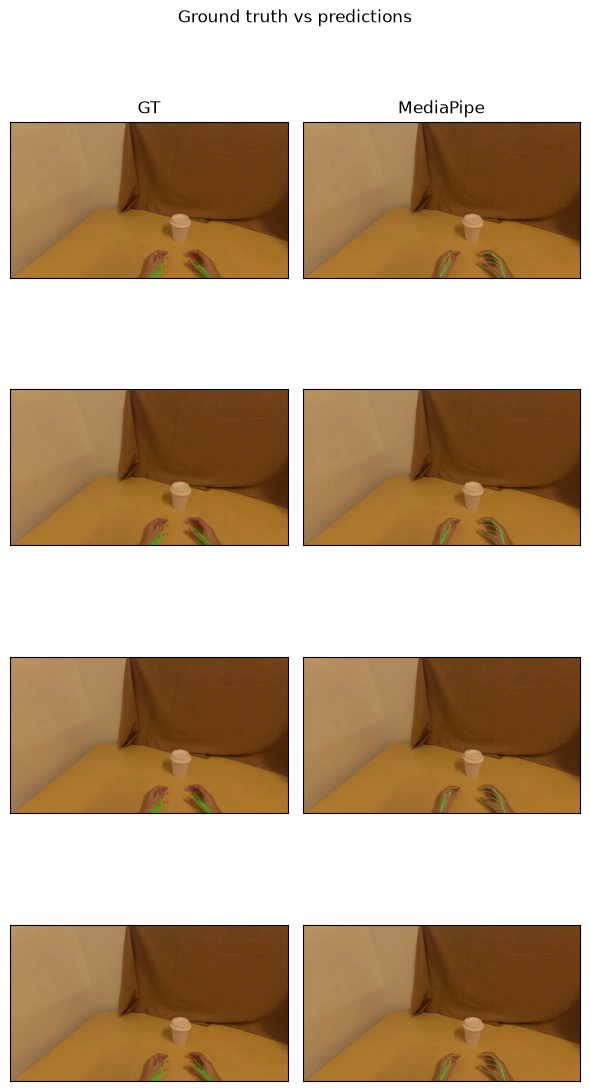
Each row is a frame; the first column is the EgoDex ground-truth hands (green), the rest are the predicted keypoints. This is the most telling view - you see where each method is right and where it misses.

 1
 2
 3
 4
 5
 6
 7
 8
 9
10
11
12
13
14
15
16
17
18
19
20
21
22
23
24
25
26
27
28
29
30
31
32
33
34
# --- Visualize: draw the predicted keypoints on a few frames ---
import cv2
import matplotlib.pyplot as plt
import numpy as np

# 21-keypoint hand skeleton (wrist + 5 fingers x 4 joints)
BONES = [(0, 1), (1, 2), (2, 3), (3, 4), (0, 5), (5, 6), (6, 7), (7, 8),
         (0, 9), (9, 10), (10, 11), (11, 12), (0, 13), (13, 14), (14, 15),
         (15, 16), (0, 17), (17, 18), (18, 19), (19, 20)]


def draw_hands(img, hands):
    img = np.ascontiguousarray(img)
    for h in hands or []:
        kp = np.asarray(h["kp2d"], float)
        for a, b in BONES:
            cv2.line(img, tuple(kp[a].astype(int)), tuple(kp[b].astype(int)), (60, 200, 60), 2)
        for p in kp:
            cv2.circle(img, tuple(p.astype(int)), 3, (255, 80, 0), -1)
    return img

def draw_gt(img, state, extr):
    """Draw the projected EgoDex GT hands (wrist + fingertips) in green."""
    img = np.ascontiguousarray(img)
    for side in (0, 1):
        uv = _project(_hand_pts(np.asarray(state, float), side), extr)
        if not np.isfinite(uv).all():
            continue
        wrist = tuple(uv[0].astype(int))
        for tip in uv[1:]:
            cv2.line(img, wrist, tuple(tip.astype(int)), (0, 220, 0), 2)
            cv2.circle(img, tuple(tip.astype(int)), 5, (255, 0, 0), -1)
        cv2.circle(img, wrist, 6, (0, 120, 255), -1)
    return img
 1
 2
 3
 4
 5
 6
 7
 8
 9
10
11
12
13
14
15
16
17
viz = df.select(IMAGE_COLUMN, "observation.state", "observation.extrinsics", "hands").limit(4).to_pydict()
columns = [("GT", None)] + [("MediaPipe", "hands")]
n = len(viz["frame_index"]) if "frame_index" in viz else len(viz[IMAGE_COLUMN])
fig, axes = plt.subplots(n, len(columns), figsize=(3 * len(columns), 3 * n), squeeze=False)
for i in range(n):
    img = np.asarray(viz[IMAGE_COLUMN][i])
    for jc, (label, c) in enumerate(columns):
        cell = (draw_gt(img.copy(), viz["observation.state"][i], viz["observation.extrinsics"][i])
                if c is None else draw_hands(img.copy(), viz[c][i]))
        axes[i][jc].imshow(cell)
        axes[i][jc].set_xticks([])
        axes[i][jc].set_yticks([])
        if i == 0:
            axes[i][jc].set_title(label)
fig.suptitle("Ground truth vs predictions")
plt.tight_layout()
plt.show()

track_hands keypoints